Product Introduction:
Shanghai Yuke utilizes the internationally advanced U-tube oscillation principle. By exciting the natural oscillation of the U-tube and leveraging the physical property where oscillation frequency shifts in response to changes in liquid density, the system rapidly calculates sample density and relative density. Requiring only a small sample volume (1.5 mL), the instrument delivers high-precision measurements within seconds, achieving a resolution of 0.00001 g/cm³.
Compared to traditional methods—such as the volumetric flask, hydrometer, and balance-based density measurement techniques—the Smart-D90 series automatic density meters offer significant advantages, including minimal sample consumption, precise temperature control, ease of operation, high accuracy, and excellent repeatability. By innovatively integrating Peltier-based precision temperature control (±0.02°C) with high-definition video imaging, the instrument not only ensures accurate, stable, and reliable test results but also allows for real-time monitoring of the sample injection process and easy detection of air bubbles, delivering an efficient and intuitive testing experience.
Key Innovations:
l 1. The instrument's circuitry features an innovative EMC (Electromagnetic Compatibility) design, comprehensively optimized from PCB layout and shielding structures to filtering circuits. This effectively suppresses external electromagnetic interference and minimizes the instrument's own electromagnetic emissions. It maintains a high signal-to-noise ratio in the signal chain—even in complex industrial electromagnetic environments—ensuring precise and stable oscillation frequency acquisition.
l 2. The sampling circuitry employs innovative board-level temperature control technology, providing active temperature compensation and constant-temperature regulation for critical analog components and frequency acquisition chips. This effectively eliminates component drift caused by ambient temperature fluctuations, ensuring sampling accuracy and long-term stability for the oscillation frequency signal.
l 3. The constant-temperature chamber is constructed from high-purity oxygen-free copper; its excellent thermal conductivity and high heat capacity facilitate rapid, uniform heat transfer and significantly enhance thermal storage and stability. The chamber is encased in a polyurethane insulation layer—featuring an extremely low thermal conductivity (approx. 0.02–0.03 W/m·K) and a closed-cell structure—which creates a highly efficient thermal barrier. This effectively prevents heat loss and shields the chamber from external temperature fluctuations, ensuring a highly stable internal thermal environment and providing a solid physical foundation for precise temperature control within ±0.02°C.
l 4. The instrument utilizes a water-cooling system that efficiently dissipates waste heat generated by the Peltier modules and circuitry via circulating coolant, offering heat dissipation efficiency far superior to traditional air-cooling methods. Rapid heat removal prevents heat accumulation, ensuring core internal components operate within their optimal temperature ranges, thereby guaranteeing stability and measurement accuracy during prolonged, continuous operation.
l 5. The instrument chamber is equipped with an independent vibration isolation system utilizing high-damping materials and a floating structural design. This effectively isolates the U-shaped oscillation tube from mechanical interference caused by external vibrations (such as equipment operation or personnel movement). By maintaining the U-tube in a stable mechanical environment and preventing vibration-induced frequency drift, the system ensures measurement accuracy and repeatability at the source.
l 6. The instrument features a CNC-machined 6061 aluminum alloy housing, finished with fine sandblasting and a gunmetal-grey anodized coating. The 6061 aluminum alloy combines lightweight properties with high rigidity, effectively protecting internal precision components; the dense anodized coating is wear-resistant, fingerprint-resistant, and colorfast, ensuring durability during long-term use.
Features:
l 1. Based on the U-tube oscillation principle, the instrument achieves rapid, stable, and non-destructive density measurement through high-precision frequency detection, combining sub-second response times with laboratory-grade accuracy.
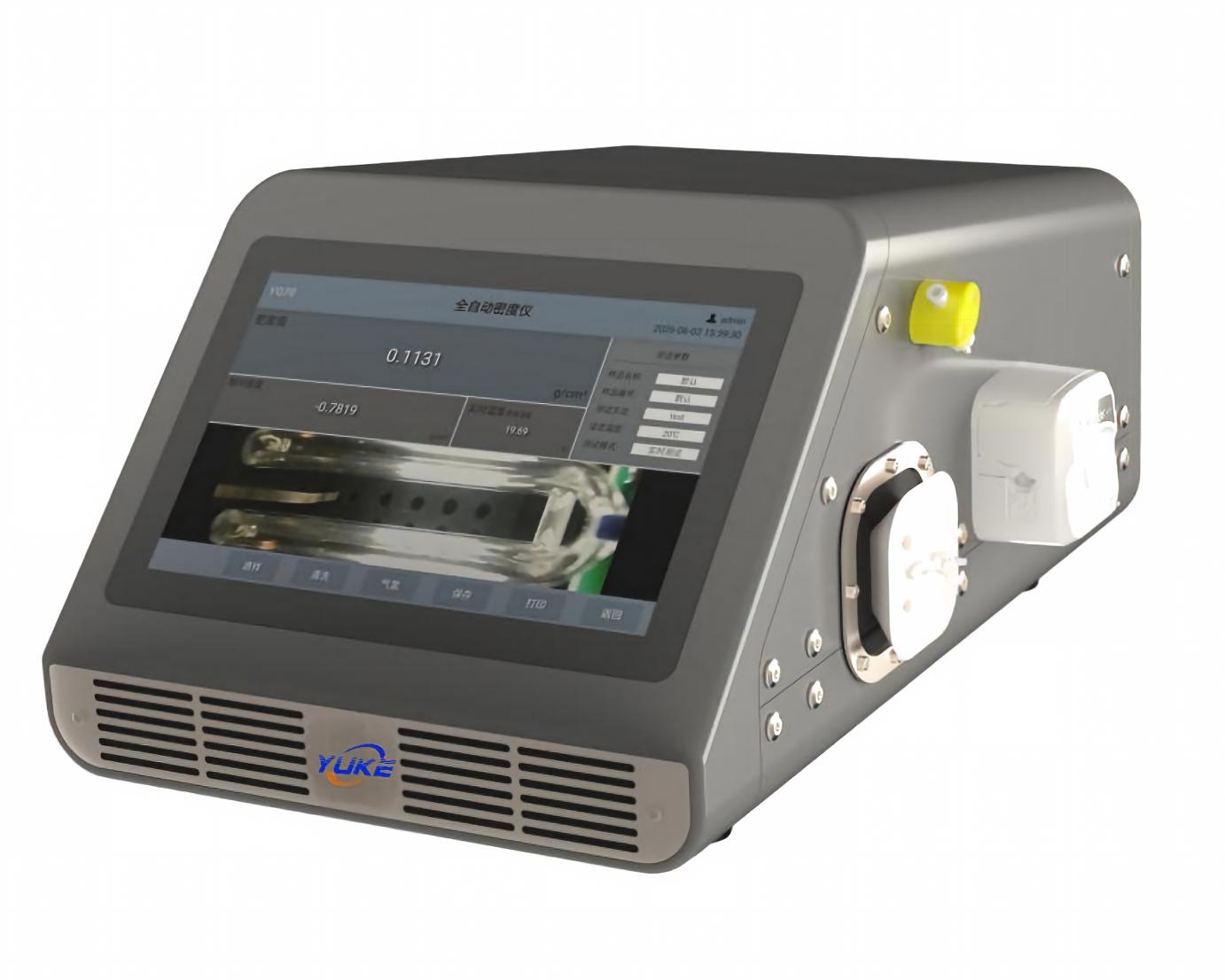
l 2. Equipped with a 10.1-inch high-definition color touchscreen, the instrument features a clear, intuitive interface that displays measurement parameters, real-time data, and historical records on a single screen.
l 3. A built-in high-definition camera allows for direct observation of sample injection, residual bubbles, and liquid flow within the U-shaped oscillation tube. This ensures complete sample filling and the absence of bubble interference prior to measurement, guaranteeing data reliability at the source.
l 4. The entire series integrates a dual-pump system comprising a high-precision peristaltic pump for sample injection and a built-in drying pump. The peristaltic pump ensures smooth sample delivery via the periodic compression of flexible tubing, preventing shear forces from altering sample properties; the drying pump automatically purges and dries the U-tube and flow path between measurements, ensuring no residual liquid remains and creating a clean environment for subsequent high-precision readings.
l 5. The instrument offers exceptional sample utilization efficiency, requiring a minimum manual injection volume of just 1.5 mL. This micro-injection design minimizes sample consumption—making it ideal for analyzing high-value or small-volume liquid samples—while balancing cost-effectiveness with measurement precision.
l 6. Built-in bidirectional Peltier semiconductor temperature control offers ±0.02°C precision and rapid heating/cooling capabilities. This eliminates long wait times between startup and readiness, facilitating efficient, continuous measurement of large sample batches.
l 7. The instrument includes multiple built-in measurement methods, covering standard modes such as density and relative density, as well as customizable modes for industries like pharmaceuticals, chemicals, and petroleum. It flexibly adapts to diverse sample characteristics and industry standards to meet varied testing requirements.
l 8. A two-point calibration method is employed, utilizing dry air and distilled water as reference media. Users simply follow on-screen prompts to inject the samples, and the system automatically corrects slope and offset values. This ensures long-term accuracy and traceability, fully complying with ISO, GLP, and other regulatory requirements for periodic density meter calibration.
l 9. The instrument features a built-in network module and multiple communication interfaces—including USB, RS232, and LAN—supporting seamless integration with LIMS. Measurement results can be stored locally, printed via an external printer, or exported to a computer, enabling unified data management (storage, printing, and export) and easy integration into laboratory information systems.
l 10. It employs a four-level user permission management system, complemented by audit trails, electronic signatures, and tamper-proof mechanisms compliant with 21 CFR Part 11; this ensures full data traceability and meets FDA/GMP compliance audit requirements.
Industry Applications:
1. Brewing Industry: Measurement of alcohol concentration in *baijiu* (Chinese spirits), yellow rice wine, red wine, beer, fruit wine, rice wine, etc.
2. Flavors & Fragrances: Quality verification of raw materials for food flavors, daily-use fragrances, tobacco flavors, and food additives.
3. Pharmaceutical Industry: Quality control of active pharmaceutical ingredients (APIs) and intermediates; determination of specific gravity and density of pharmaceutical preparations.
4. Beverage Industry: Measurement of sugar concentration; quality control for fruit juice, herbal tea, food additives, and soft drinks.
5. Food Industry: Quality control for grape juice, tomato juice, fruit syrups, vegetable oils, and canned food processing.
6. Petrochemical Industry: Crude oil API gravity; density testing for gasoline and diesel; monitoring of additive blending processes.
7. Chemical Industry: Concentration testing for urea, detergents, ethylene glycol, acids/alkalis, and aqueous ammonia.
8. Machinery Manufacturing: Testing of cleaning agents for metalworking, machinery manufacturing, the automotive industry, and electronics/electrical appliances.
9. Testing Institutions: Liquid density measurement for standard laboratories, statutory testing agencies, and third-party testing services.
Relevant Standards:
l Food Industry: GB/T 5009.2-2024 "Determination of relative density of food"; GB/T 10345-2007 "Methods of analysis for *baijiu*"; GB/T 4928-2008 "Methods of analysis for beer"; GB/T 15038-2006 "General methods of analysis for wines and fruit wines"; GB/T 5009.225-2023 "Determination of ethanol concentration in alcoholic beverages."
l GB/T 29617-2013 Test method for density, relative density, and API gravity of liquids by digital density meter.
l GB/T 2013-2010 Determination of density for liquid petrochemical products (U-tube oscillation method).
l SH/T 0604-2000 Determination of density for crude oil and petroleum products (U-tube oscillation method).
l SN/T 2383-2009 Determination of density and relative density for liquid chemical products (Digital density meter method).
l DB/T 1231-2010 Methods for Determining the Density of Chemical Products: Digital Liquid Density Meter Method
l ASTM D4052-11 Standard Test Method for Density, Relative Density, and API Gravity of Liquids by Digital Density Meter
l ASTM D5002-13 Standard Test Method for Density and Relative Density of Crude Oils by Digital Density Analyzer
l ASTM D3505-12e1 Standard Test Method for Density or Relative Density of Pure Liquid Chemicals
l ISO 12185:1996 Crude petroleum and petroleum products—Determination of density—Oscillating U-tube method
Technical Specifications:
Parameter | Smart-D90A | Smart-D90B | Smart-D90C |
Density Measurement Range (g/cm³) | 0.00000 – 3.00000 | 0.00000 – 3.00000 | 0.00000 – 3.00000 |
Measurement Method | Built-in multiple density measurement methods for petrochemical, pharmaceutical, food, and concentration applications |
Measurement Mode | Precision Measurement / Real-time Measurement |
Custom Measurement Method | Yes |
User Management | Yes / Four-level permission management |
Electronic Signature | Yes |
Audit Trail | Yes |
Drying pump | Yes |
Automatic sampling peristaltic pump | Yes |
Measurement Resolution (g/cm³) | 0.0001 | 0.00001 | 0.00001 |
Measurement Accuracy (g/cm³) | ±0.0005 | ±0.0002 | ±0.00005 |
Measurement Repeatability (g/cm³) | ±0.0002 | ±0.0001 | ±0.00005 |
Temperature Resolution | 0.01 ℃ | 0.01 ℃ | 0.01 ℃ |
Temperature Control Range | 5 ℃ – 40 ℃ | 5 ℃ – 55 ℃ | 0 ℃ – 70 ℃ |
Temperature Control Precision | ±0.03 ℃ | ±0.02 ℃ | ±0.02 ℃ |
Temperature Control Accuracy | ±0.1 ℃ | ±0.05 ℃ | ±0.02 ℃ |
Automatic Viscosity Compensation | Built-in algorithm compensation |
Sample Injection Observation | HD camera with video observation (automatic sample injection) |
Calibration Method | Dry air / Standard water |
Data Storage | 64 GB | 128 GB | 128 GB |
Common Configurations (all models)
Parameter | Specification |
Display | 10.1" color LCD touch screen |
Operating System | Android |
Communication Interfaces | 1 × RS232, 3 × USB, 1 × RJ-45 |
Printer Type | Micro printer as option (dot-matrix, thermal), WiFi printer |
Output Report | PDF / Excel / CSV |
Power Supply | 110 V – 240 V, 50 – 60 Hz, 140 W |
Instrument Dimensions | 452 × 329 × 227 mm (L × W × H) |
Net Weight | 13.0 kg |
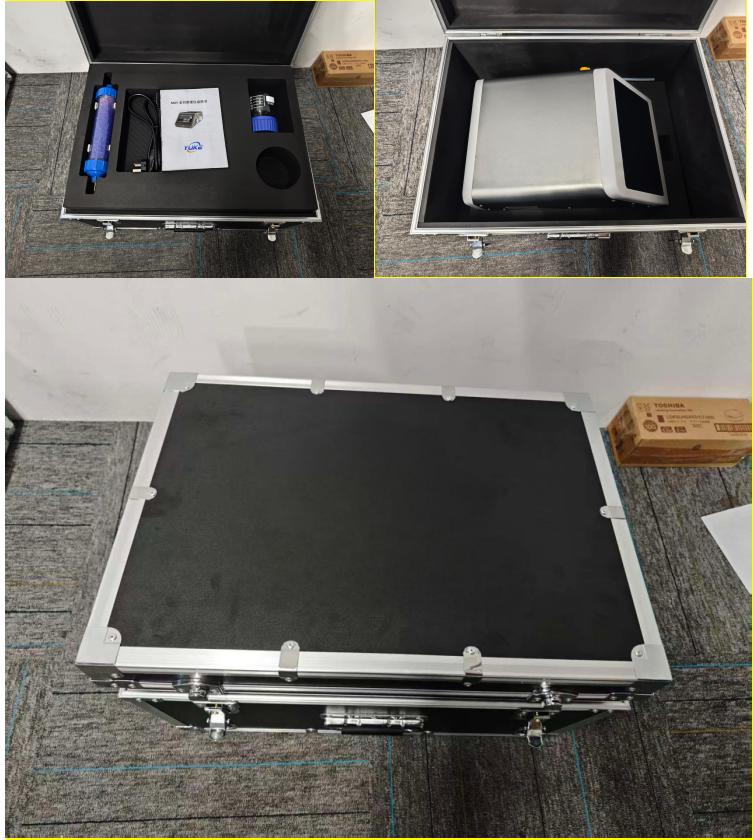
Packing details
Download
keyword search:Density Meter


 INQUIRY


